Want a Screen-Free Evening Habit? Here’s a 30-Day Plan That’s Already Made for You
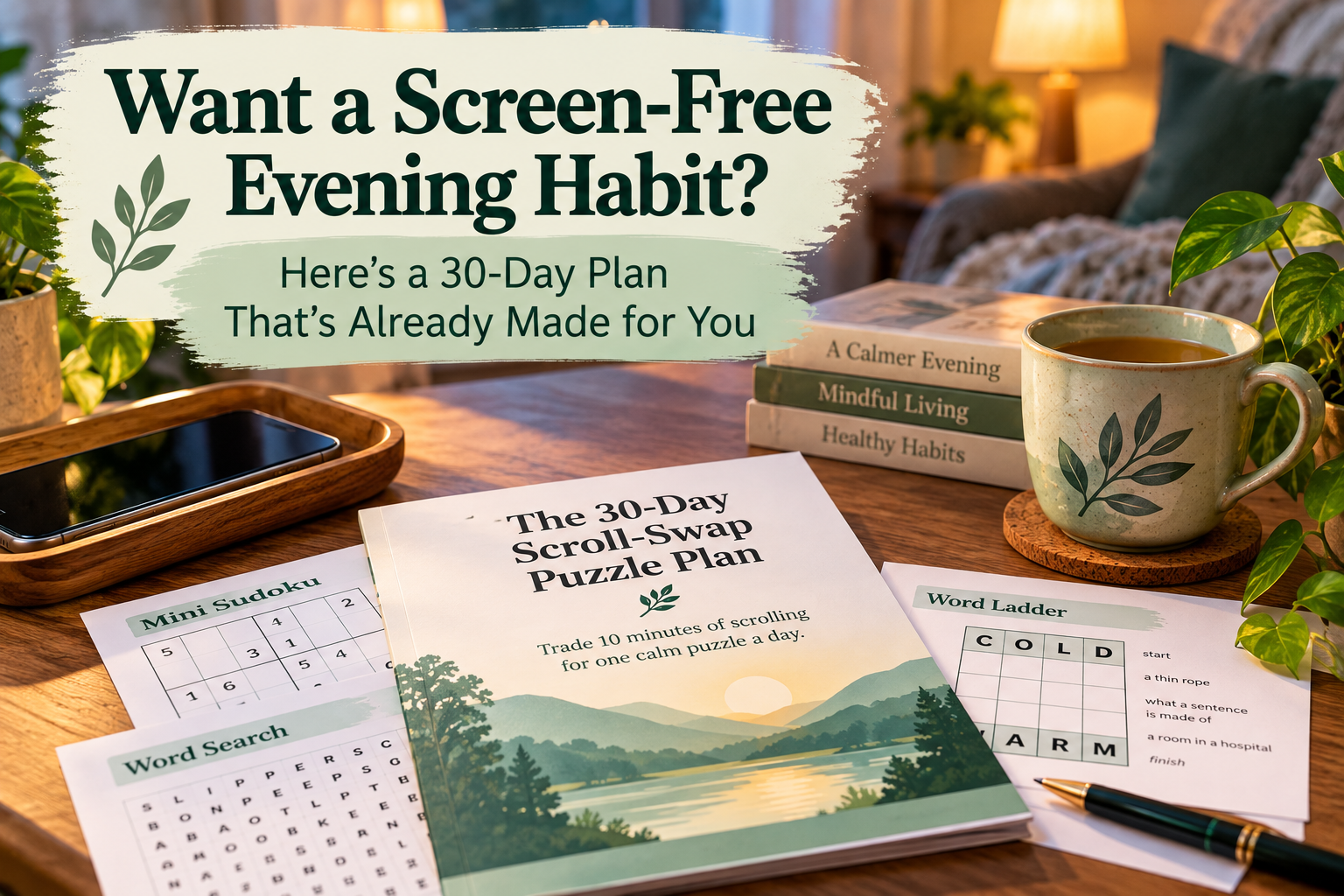
Creating a more intentional evening routine doesn’t have to mean making dramatic changes—or planning every detail yourself.
Small Changes Can Begin With Ordinary Evenings
When we think about improving our well-being, it’s easy to imagine that we need an entirely new routine.
Perhaps we should meditate every evening, spend more time reading, start journaling, or put our phones away hours before bedtime.
Those are possibilities worth exploring. But sometimes, a more approachable starting point is simply choosing one small activity and making room for it in our existing schedule.
Consider the time we spend scrolling on our phones.
Our devices help us communicate, learn, and stay entertained. There’s nothing inherently wrong with enjoying them. Yet it’s worth occasionally asking whether we’re using them intentionally or simply reaching for them out of habit.
What if you chose just 10 minutes of your evening to do something different?
You could read a few pages, work on a puzzle, write in a journal, or simply sit quietly.
The activity itself doesn’t need to be elaborate.
But there’s a practical question that often arises when we decide to try a new routine:
Should we create our own plan, or choose something that’s already organized for us?
The Difference Between a Good Intention and a Ready-to-Use Plan
Suppose you’ve decided to introduce a short screen-free activity into your evening.
You like the idea of spending a few minutes away from your phone, and perhaps you’ve already considered some possible activities.
Now comes the planning.
What will you do each evening? Where will you find the materials? How will you remember what you’ve tried? Will you track your participation?
And what happens when your schedule changes or you miss a day?
You could certainly answer those questions yourself.
You might gather puzzles from different sources, print worksheets, design a habit tracker, and create a calendar for the next month.
For someone who enjoys organizing projects, that preparation might even be part of the fun.
But not everyone wants to turn a small wellness intention into a planning project.
Sometimes it’s appealing to have the activities and supporting materials already gathered in one place.
That’s where a ready-made plan can be useful.
You still decide when to participate and how to approach the activities, but you begin with an established structure rather than a blank page.
Why Start With Just 10 Minutes?
A screen-free evening doesn’t have to mean spending hours disconnected from technology.
You might simply choose a familiar moment when you tend to reach for your phone and experiment with a different activity.
Ten minutes provides a clearly defined starting point.
It’s short enough to fit into many ordinary evenings without requiring an entirely new schedule.
You might try it after dinner, while relaxing in your favorite chair, or during another convenient part of your evening.
And you don’t need to make the same choice forever.
You can simply see what it’s like to spend those minutes doing something else.
One possibility is working on a paper puzzle.
A word search, mini sudoku, or logic puzzle gives you something specific to focus on without opening another app.
There’s no requirement to complete a complicated project or achieve a particular result.
You can simply pick up a pencil and begin.
A Personal Observation About Our Phone Habits
I’m Ralph Lorenz, a certified Tai Chi instructor and certified Qigong trainer with more than 40 years of experience.
Throughout my work with these practices, I’ve come to appreciate the importance of awareness in everyday life.
But I’ve also noticed something about our increasingly connected world.
We spend an extraordinary amount of time looking at our phones—and I certainly include myself in that observation!
Our phones are useful, entertaining, and an important part of modern life. I’m not interested in suggesting that people abandon them.
Still, I’ve found myself wondering how often we reach for them simply because it’s become such a familiar part of our routine.
That observation inspired me to create a simple resource called The 30-Day Scroll-Swap Puzzle Plan.
The idea isn’t to transform your entire relationship with technology overnight.
It’s to offer a practical alternative for one small part of the evening.
Instead of automatically scrolling, you can choose to spend approximately 10 minutes working on a printable puzzle.
And rather than having to organize a month’s worth of activities yourself, you can begin with a prepared plan.
Introducing The 30-Day Scroll-Swap Puzzle Plan
The 30-Day Scroll-Swap Puzzle Plan is a 45-page printable PDF designed to help adults experiment with replacing habitual evening scrolling with a short, screen-free activity.
The complete plan includes 30 original puzzles with answers, along with tools for tracking participation, observing phone habits, and reflecting on the experience.
It’s available as an instant digital download for $12.
The central idea is straightforward:
Keep the familiar evening moment. Change what you do with it.
Rather than concentrating entirely on avoiding your phone, you have an alternative activity ready to use.
The plan brings the puzzles and supporting materials together in one organized resource.
What’s Included in the 30-Day Plan?
Thirty Original Puzzles With Answers
The plan includes 30 puzzles representing six varieties:
- Mini sudoku
- Word search
- Word ladder
- Cryptogram
- Logic grid
- Number pyramid
The different puzzle types provide variety throughout the 30-day experience.
Instead of searching for a new activity each evening, you can turn to the next puzzle.
Complete answers are included for reference.
Quick Start Guidance
A prepared plan should make it clear how to begin.
The Scroll-Swap Puzzle Plan includes a Quick Start section introducing its daily approach.
The routine follows five simple steps:
- Catch the moment when you would ordinarily begin scrolling.
- Park your phone.
- Check in with how you’re feeling.
- Spend approximately 10 minutes working on a puzzle.
- Check in again afterward.
The sequence gives each day’s activity a consistent structure without requiring a complicated routine.
Implementation Checklists
The plan includes checklists to support getting started.
These materials help organize the process of preparing for the 30-day experiment.
Instead of creating your own set of instructions, you can refer to the guidance already included.
A Daily Habit Tracker and Screen-Time Log
If you’re experimenting with a new routine, you may want a way to record what you’re doing.
The included daily habit tracker provides a place to record participation.
The screen-time log allows you to document information about your phone use.
These tools can help you observe your experience over the course of the plan.
They don’t guarantee that you’ll reduce your screen time by a particular amount. Rather, they provide a framework for your own observations.
Trigger-Swap Cards
The plan also includes cut-out trigger-swap cards.
These are designed to support the idea of recognizing familiar phone-use moments and choosing an alternative activity.
For example, when you notice yourself about to reach for your phone, you might decide to work on the day’s puzzle instead.
The cards reinforce the connection between noticing a habit and making a conscious choice.
Before-and-After Mood Check-Ins
Another feature is the opportunity to notice how you’re feeling before and after the activity.
You might ask yourself:
How am I feeling right now?
And afterward:
What do I notice?
There’s no requirement to feel a certain way.
The purpose is simply to make room for observation and reflection.
Missed-Day Guidance and a Day 30 Review
Even a short daily activity has to fit into real life.
Schedules change, unexpected events occur, and sometimes we simply forget.
The plan includes guidance for missed days, along with a Day 30 review.
These materials give you a way to continue your experiment and reflect on it at the end.
The intention is to explore a different routine, not to create another standard of perfection.
Should You Build Your Own Routine or Use a Prepared Plan?
This is really the central question for anyone considering a ready-made wellness resource.
If you enjoy gathering materials, designing trackers, and organizing activities, creating your own screen-free evening plan may be appealing.
You could collect puzzles, create reflection questions, and develop a system for tracking your participation.
There’s nothing wrong with that approach.
But perhaps you’ve already decided that you want to try something different in the evening, and you’d rather focus on the activity itself.
A prepared resource gives you that option.
With The 30-Day Scroll-Swap Puzzle Plan, the puzzles, answers, tracking materials, reflection tools, and guidance are already brought together.
For $12, you’re purchasing an organized set of materials designed around a specific 30-day experiment.
You’re not purchasing a guarantee of changed habits or improved well-being.
You’re choosing a structured activity that you can use to explore a small adjustment to your evening routine.
Whether that convenience is worthwhile depends on your preferences.
What Might an Evening With the Plan Look Like?
Imagine you’ve chosen the time shortly after dinner for your screen-free activity.
You settle into a comfortable chair and notice yourself reaching for your phone.
Instead, you set it aside.
You take a moment to notice how you’re feeling.
Then you open your printed plan to the next puzzle and spend approximately 10 minutes working on it.
When you’re finished, you check in with yourself again and use the tracking materials if you’d like to record the experience.
That’s the basic idea.
You haven’t committed to giving up technology for the rest of the evening.
You haven’t added a complicated new routine.
You’ve simply experimented with spending a familiar moment in a different way.
And when you’re ready for the next session, another puzzle is waiting.
Bringing Mindfulness Into Ordinary Moments
At Five Element Harmony, the mindful-living project I founded, I often return to the idea that awareness can be part of everyday activities.
It doesn’t always require a formal meditation session.
Sometimes it begins when we notice what we’re doing and consciously choose what happens next.
That perspective is reflected in the Scroll-Swap approach.
You notice the familiar urge to scroll. You set the phone aside. You give your attention to a puzzle. And you take a moment to observe your experience.
The plan isn’t a Tai Chi or Qigong course, and it doesn’t promise therapeutic results.
It’s a practical, puzzle-based resource informed by a philosophy of bringing more intention into daily life.
For me, that makes it a natural extension of the work I share through Five Element Harmony.
Ready to Try a Screen-Free Evening Activity?
If you’ve been thinking about adding a short screen-free activity to your evenings, you don’t necessarily have to create a plan from scratch.
You can begin with a prepared collection of puzzles and supporting materials.
The 30-Day Scroll-Swap Puzzle Plan includes:
- A 45-page printable PDF
- 30 original puzzles with complete answers
- Six puzzle varieties
- Quick Start guidance and implementation checklists
- Daily habit tracking and screen-time logging
- Trigger-swap cards
- Before-and-after mood check-ins
- Guidance for missed days and a Day 30 review
The complete plan is available for $12 as an instant digital download, formatted for US Letter paper with A4 scaling instructions.
I created this resource because I’ve noticed how easily our phones can become the default activity during ordinary moments—and because I recognize that tendency in myself, too.
My invitation is simple:
You don’t have to plan 30 evenings. You can begin with one puzzle.
Explore The 30-Day Scroll-Swap Puzzle Plan on Payhip — $12 →
About the author: Ralph Lorenz, PhD, is a certified Tai Chi instructor and certified Qigong trainer with more than 40 years of experience. He is the founder of Five Element Harmony, where he shares approaches to mindfulness, awareness, and intentional living. Visit FiveElementHarmony.com.