Learning Breathing Exercises? Why Seeing a Demonstration Can Make All the Difference
Discover how written instructions, posture guidance, and follow-along videos can help you begin exploring mindful breathing with greater clarity.
Breathing exercises are an increasingly familiar part of conversations about relaxation, stress management, and holistic wellness. From mindful breathing to practices associated with Tai Chi and Qigong, there are many ways to explore the relationship between breathing, attention, and body awareness.
But deciding to try breathing exercises is only the beginning.
Once you’ve made that decision, another question arises: What’s the best way to learn how to perform them?
You could read articles, collect instructions from different websites, or watch individual videos. Each approach has value.
However, if you’re considering purchasing a breathing-exercise guide, there’s one feature worth looking for: the opportunity to see the techniques demonstrated before practicing them.
That’s the idea behind The Healing Breath: Five Essential Breathing Exercises for Natural Pain Relief, a downloadable guide combining written instruction with video demonstrations.
Why Written Breathing Instructions May Not Tell the Whole Story
At first glance, breathing exercises might seem unusually easy to explain.
After all, breathing is something everyone does naturally.
Yet intentional breathing involves more than simply inhaling and exhaling. Depending on the technique, a practice may involve posture, physical awareness, focused attention, and a particular approach to the breath.
Written instructions can explain these elements, but readers must still interpret what those words mean in practice.
Consider posture.
A written description may tell you how to position your body, but seeing someone demonstrate that position can provide an additional point of reference.
Similarly, a description of a breathing technique may become easier to understand when you can observe its sequence.
This doesn’t make written instructions unnecessary. Quite the opposite.
Written explanations and visual demonstrations can complement each other, giving learners two different ways to approach the same exercise.
For someone choosing between a text-only resource and one that includes demonstrations, this combination may be an important consideration.
The Value of Watching Before Practicing
Think about how people learn other physical activities.
Whether it’s Tai Chi, Qigong, Yoga, or a musical technique, instruction often includes both explanation and demonstration.
A teacher describes an action and then shows how it is performed.
The learner can observe, ask questions when instruction is interactive, and begin exploring the technique.
Breathing exercises can benefit from a similar instructional approach.
Watching a demonstration provides an opportunity to observe how the instructor approaches the exercise.
It may help clarify the relationship between posture and breathing, the general sequence of the practice, and how the different elements fit together.
For someone learning independently, video demonstrations can be especially appealing.
Instead of relying exclusively on written descriptions, the learner can refer to a visual example.
And when the demonstration includes a follow-along sequence, the learner has an opportunity to practice alongside the instruction.
This is one reason to consider the instructional format carefully before purchasing a breathing guide.
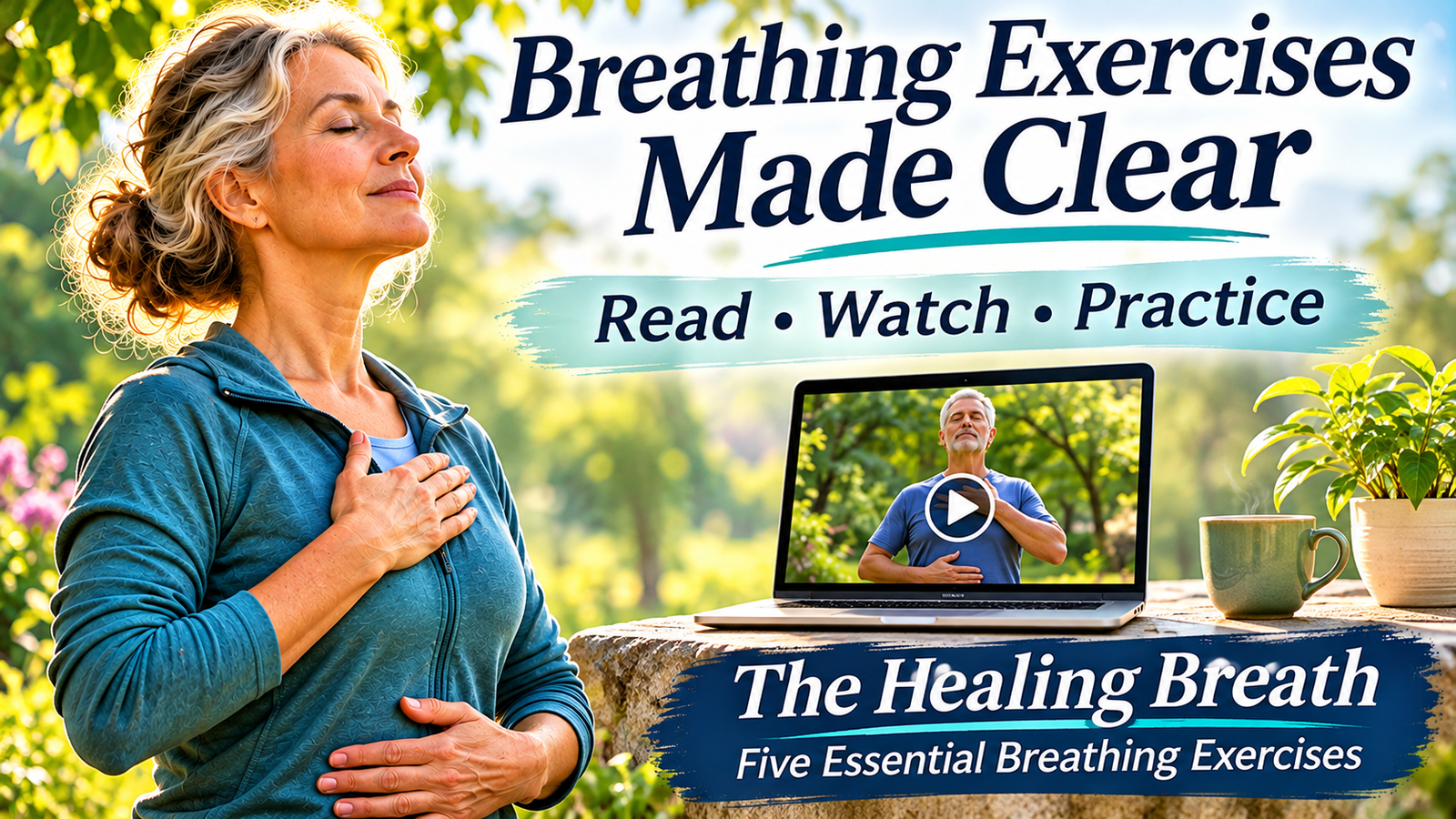
Read, Watch, and Practice: A Three-Part Approach
A breathing resource that combines written explanations with demonstrations offers a straightforward learning sequence.
Step 1: Read the Instructions
Begin by reviewing the written explanation.
This provides an introduction to the technique and helps you understand what the exercise involves.
Written material also serves as a convenient reference when you want to revisit an explanation.
Step 2: Watch the Demonstration
Next, observe the technique being performed.
Pay attention to the instructor’s posture and the overall approach to the exercise.
The demonstration can help put the written description into a visual context.
Step 3: Follow Along
Once you’ve reviewed the instructions and watched the demonstration, you can explore the technique through guided practice.
The goal isn’t to achieve a particular result immediately.
It’s to become familiar with the exercise and develop a clearer understanding of what you’re doing.
This read-watch-practice sequence is particularly relevant to people who have already decided to explore breathing exercises but want more guidance than written instructions alone.
Introducing The Healing Breath
The Healing Breath: Five Essential Breathing Exercises for Natural Pain Relief was created by Ralph Lorenz, PhD, founder of Five Element Harmony.
The guide brings together five breathing techniques in a 12-page downloadable PDF.
Each exercise includes complete written instructions, posture guidance, and a link to a video demonstration with a follow-along sequence.
This means purchasers aren’t limited to reading about the exercises.
They can also see the techniques demonstrated and use the accompanying videos as they begin practicing.
The guide is designed as an accessible introduction to breathing techniques associated with pain management, relaxation, and personal wellness.
Rather than presenting an extensive collection of unrelated information, it focuses on five specific exercises.
Five Breathing Exercises With Different Purposes
The guide includes five techniques, each emphasizing a different aspect of breathing practice.
1. Pain-Relief Breath
This deep, focused breathing technique is presented as an approach to exploring breath awareness in relation to pain management.
It introduces a specific breathing practice for those interested in incorporating breathwork into their broader wellness activities.
2. Grounding
Grounding focuses on cultivating calm and releasing tension.
It offers an opportunity to explore breathing as a way of directing attention toward the present moment.
3. Energizing
Breathing practices aren’t exclusively about relaxation.
The Energizing technique emphasizes vitality and the experience of renewed energy.
4. Soothing
Soothing focuses on relaxation and inner calm.
It introduces a breathing approach intended to encourage a more peaceful experience.
5. Restoration
Restoration emphasizes reconnecting with inner calm and exploring a sense of balance.
Together, these five exercises provide several different approaches to intentional breathing.
Importantly, the guide doesn’t require readers to learn these techniques through text alone.
Each exercise is accompanied by a video demonstration and follow-along sequence.
Why Posture Guidance Deserves Attention
One useful feature of The Healing Breath is its inclusion of posture instructions.
Posture is an important consideration in many mindful movement and breathing disciplines.
In Tai Chi and Qigong, for example, attention to body alignment is part of the broader practice.
Breathing exercises may also involve awareness of how the body is positioned.
A guide that includes posture instructions gives learners another element to consider as they explore a technique.
And when written posture guidance is paired with a demonstration, readers can compare the explanation with what they observe.
For someone deciding whether to purchase an instructional resource, this additional guidance may help distinguish it from a collection of brief breathing tips.
Learning From an Instructor With a Background in Breath-Centered Practices
When purchasing an educational wellness resource, it’s reasonable to consider the instructor’s background.
The Healing Breath was written by Ralph Lorenz, PhD, whose professional experience includes university teaching, music, Tai Chi, and Qigong.
Lorenz holds a doctorate in Music Theory from Indiana University and spent his career as a university music professor and arts administrator.
He also holds teaching certifications in Tai Chi and Qigong.
His approach to breathwork draws on experience with these disciplines, along with choral singing and some Yoga.
This combination provides a distinctive educational perspective.
Breathing is an important consideration in singing, while breath awareness also plays a role in Tai Chi and Qigong.
Lorenz brings these areas of experience together in an instructional guide intended to make five breathing techniques accessible to people who want to explore them.
These are educational and movement-related qualifications, rather than medical credentials.
A Practical Alternative to Collecting Separate Instructions
There’s no shortage of information about breathing exercises online.
Someone interested in breathwork can find articles, demonstrations, and explanations from many different sources.
But when the goal changes from researching breathing techniques to actually learning them, the organization of the material becomes more important.
A prospective buyer may begin asking practical questions.
Will the resource explain what to do?
Will it show how the techniques are performed?
Does it include guidance about posture?
Can the instructions be accessed conveniently?
These are reasonable considerations when comparing breathing guides.
The Healing Breath addresses them by bringing five exercises, written instructions, posture guidance, and linked demonstrations into one downloadable resource.
The PDF can be opened on a desktop computer, laptop, tablet, or smartphone.
No dedicated ebook reader is required.
The included video links take readers to demonstrations and follow-along sequences.
For someone who prefers a coordinated instructional resource rather than collecting separate materials, this format offers a convenient option.
What You Receive With The Healing Breath
The guide is available through Gumroad for $17.
The purchase includes:
- One downloadable PDF containing 12 pages.
- Complete written instructions for five breathing exercises.
- Posture guidance.
- Video demonstration and follow-along links for each exercise.
- Instant digital access after purchase.
The downloadable file is 13.3 MB, and the listing includes a 14-day money-back guarantee.
The emphasis is on providing practical instruction rather than promising a particular health outcome.
Breathing exercises may be explored as part of a broader wellness routine, but they should not be regarded as cures for pain or substitutes for appropriate medical treatment.
Choosing a Breathing Guide That Fits the Way You Learn
Before purchasing any instructional resource, it’s worth considering how you prefer to learn.
Some people are comfortable following written explanations.
Others find that demonstrations help clarify physical techniques.
Many appreciate having both.
If you’ve decided to explore breathing exercises for pain management, relaxation, or mindful awareness, consider whether a guide with video demonstrations would make the learning process more approachable.
Look for clear explanations, guidance about posture, and opportunities to observe the exercises before practicing.
The Healing Breath combines these elements in one downloadable guide.
Its five techniques provide a focused introduction, while the written instructions and linked videos offer different ways to engage with the material.
Ready to Move From Reading to Practicing?
Learning about breathing exercises can be interesting, but eventually the next step is to explore a technique for yourself.
You don’t necessarily need an extensive course or a large collection of materials to begin.
A manageable guide with clear instructions and demonstrations may be enough to help you take that first step.
If you’d like to learn five breathing techniques with both written and visual guidance, The Healing Breath is available for immediate download.
Explore The Healing Breath and Get Your Copy for $17
Read the instructions. Watch the demonstrations. Follow along as you practice.
Sometimes, seeing how something is done is what helps turn an interesting idea into an activity you’re ready to explore.
Educational note: Breathing exercises are not substitutes for medical diagnosis or treatment. Anyone with medical concerns about breathing practices should consult an appropriate healthcare professional.